Meet the Pilates Reformer
I’m Dr. Tanvi Maharaja, PT, DPT, OCS, PRFS, and a certified STOTT Pilates instructor. The reformer is now part of your one-on-one PT session at no additional cost, when it fits your plan of care. It lets us build strength, control and confidence in a supported, low-impact way, paced to you and guided by me for your full hour.
Beyond my STOTT Pilates training, I have trained with Gráinne Donnelly and Diane Lee—internationally recognized experts in diastasis recti (DRA) assessment and management. That training helps me look beyond the gap: how your abdominal wall handles load, how you breathe, and how your core and pelvic floor work together. The reformer is a tool; knowing how to adapt it to you is what matters.
The reformer is not just for diastasis recti (DRA). I can use it for pelvic floor strengthening and coordination, core and spine-supporting muscle strength, hip strength, and lower-leg work—all as part of your overall pelvic health. Your pelvis does not move on its own: it works with your trunk, hips, legs and breath when you walk, lift or exercise. The springs let me adjust support and resistance around your assessment and goals. If your pelvic floor is holding too much tension, we work on letting it relax before adding more strengthening.
STOTT Pilates through a pelvic floor PT lens
Pelvic PT Plus is an out-of-network provider. See Resources / FAQ for session fees and payment options.
Supported movement
Low-impact work with spring support.
Breath and control
Paced to your body and goals.
Guided one-on-one
Your full hour with me, never handed off to an aide.
Inside a reformer session
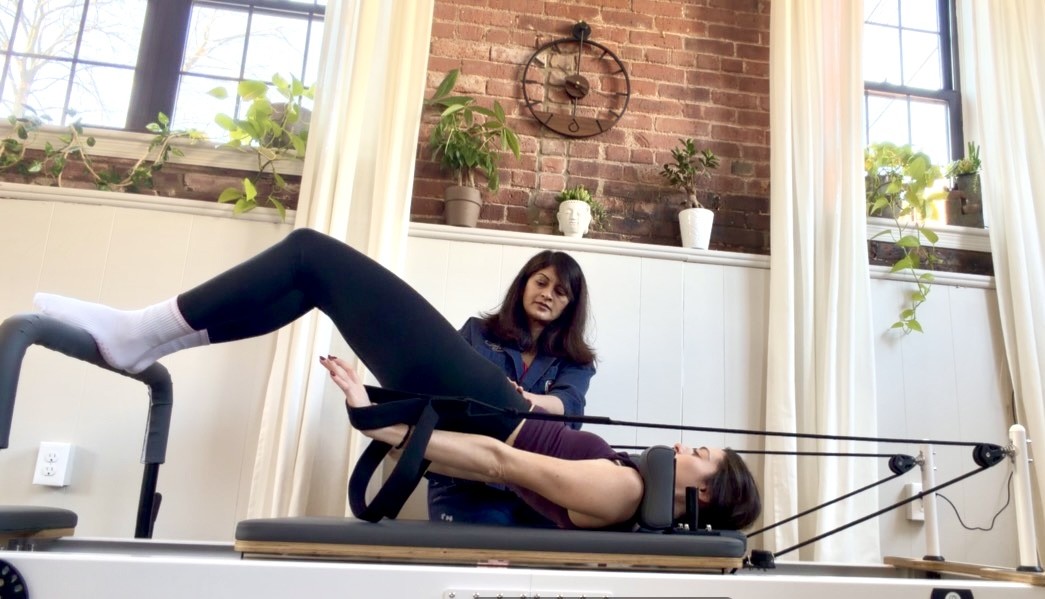
These are moments from sessions in my studio. Every movement is chosen for one person at a time—the springs, position, range and pace are set around what your body needs that day.
One-on-one guidance. I stay beside you—hand on your trunk or leg—so you can feel the movement without gripping, bracing or holding your breath.
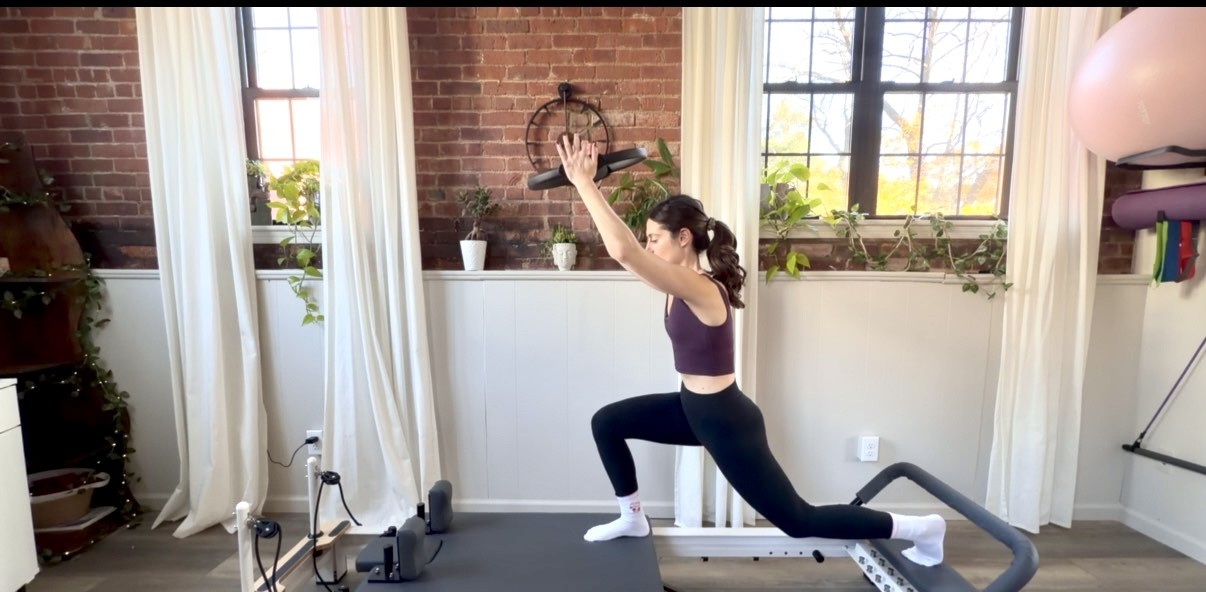
Half-kneeling work on the carriage: hips, trunk and breath working together, with spring support underneath you.
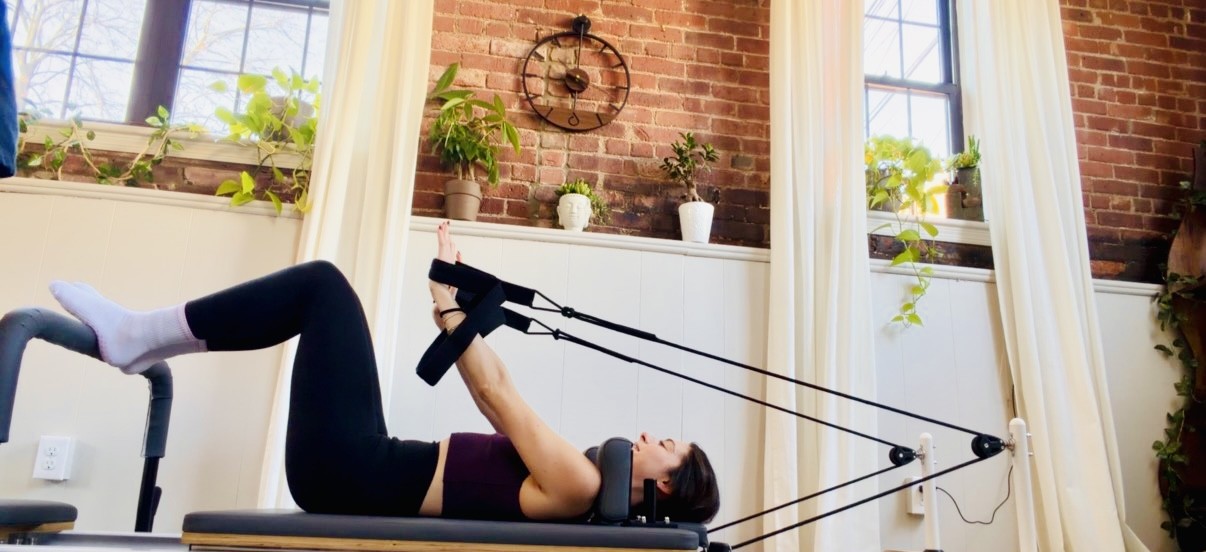
Supine work with straps and footbar: legs and hips move while your spine stays supported and your breathing stays steady.
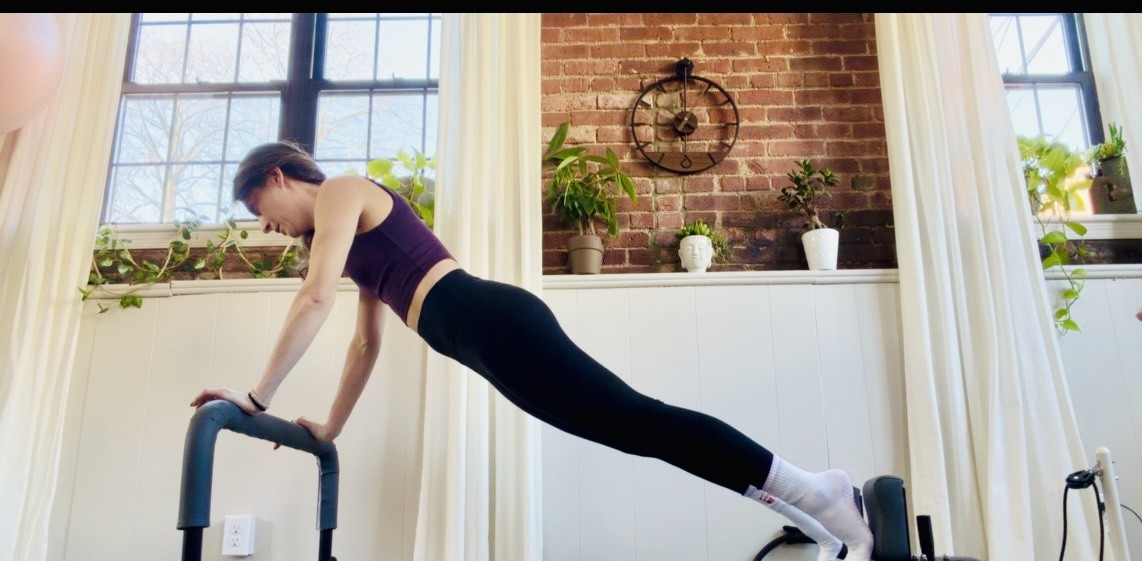
A supported plank: hands on the footbar, feet on the carriage—trunk and pelvic control under load, paced to you.
Photographs are used with the patient’s written permission and show one-on-one care in the clinic.
How this will benefit me
Pelvic health is not just about one muscle group—or a DRA gap. Your pelvic floor works with your spine, abdominal muscles, hips and lower legs. I can use the reformer to build strength and coordination across that whole system, with support and resistance tailored to you.
Pelvic floor strength—with the right timing
Your pelvic floor needs to lift, hold and fully let go. When strengthening is indicated, I can pair targeted pelvic floor training with controlled leg, hip and core movements. The goal is to carry that control into a cough, a lift or a walk—not just squeeze harder while lying still.
Spine support and a stronger trunk
Your spine needs both movement and support. I can use controlled reformer exercises to strengthen the muscles around your back and abdomen while practicing how you bend, turn and reach. We work toward sharing the effort across your trunk and pelvis—not holding your back rigid or bracing all day.
Hip strength that supports your pelvis
Your hip muscles help control your pelvis when you walk, climb stairs or stand on one leg. Reformer work lets me adjust the load as we strengthen your glutes and the muscles around your hips. The goal is coordinated support during movement, alongside the pelvic floor work you need.
Lower-leg strength, from knees to feet
Your calves, ankles and feet are part of the same movement chain as your hips and pelvis. Depending on your needs, footwork and heel-raise variations can train leg strength, ankle control and calf endurance. We connect that work to pushing off when you walk, taking stairs and returning to exercise.
Core support beyond the DRA gap
With diastasis recti, we work on how your abdominal wall creates tension and handles load. The reformer gives me ways to change the position, resistance and movement while watching your breathing and midline. Better function is the goal; a perfectly closed gap is not a promise.
Putting it together for everyday life
Think of your breath, pelvic floor, trunk, hips and legs as a team. We practice coordinating them through movement instead of holding your breath or bearing down. If your pelvic floor is tight, relaxation comes first. Then we build toward what matters to you—walking, lifting, exercise or sport—at a pace your body can manage.
What this looks like in your appointment
First, I check what your body needs
We look at your symptoms, goals, breathing, pelvic floor function, spine and hip movement, abdominal control, and leg and ankle strength when relevant. For DRA, palpation and real-time ultrasound can help assess the abdominal wall; the reformer does not replace that examination.Then, we choose a movement you can control
I adjust the springs, position, range and pace. I watch for breath-holding, uncontrolled abdominal doming, leaking, pelvic pressure or pain. Those are reasons to reassess and modify—not push through.We build from there, together
Your progress guides the next step. Your session may also include hands-on care, targeted pelvic floor training or ultrasound biofeedback. You do not have to spend the whole hour on the reformer, and you do not need one at home.
What does the research say?
Research supports targeted pelvic floor muscle training for urinary incontinence, including pregnancy and postpartum care. That is not the same as saying every Pilates exercise trains your pelvic floor adequately. A 2023 Pilates review found encouraging results, but the studies were small and of low-to-moderate quality; Pilates was not superior to specific pelvic floor physiotherapy.
A 2026 randomized trial in women with stress urinary incontinence found targeted pelvic floor muscle training performed better than the Pilates programs tested. Evidence for Pilates in general should not be presented as proof that this particular reformer or session will resolve leaking, prolapse, pain or DRA.
Hip strength and stress urinary incontinence (SUI)
A 2020 randomized trial enrolled 47 women with stress urinary incontinence (SUI)—leaking with a cough, sneeze, lift or exercise. Forty-three completed 20 sessions over 10 weeks. Adding gluteal and hip-adductor strengthening to pelvic floor training improved daily leakage frequency on the follow-up diary measure. It did not show greater improvement on the separate 3-day diary, pelvic floor strength or quality of life compared with pelvic floor training alone.
That gives me a reason to assess your hips as well as your pelvic floor—not a reason to replace pelvic floor treatment with hip exercises. The trial did not test a Pilates reformer, and it does not establish that hip weakness causes leaking or that reformer exercise alone treats SUI.
A separate small study of 33 women with SUI found no significant correlation between hip muscle strength and pelvic floor strength or endurance. A strong hip is not a measurement of a strong pelvic floor. These studies ask different questions: association is not the same as the effect of adding exercise to treatment.
Incontinence care · Women’s urinary incontinence care
Core strengthening and DRA
A 2023 review of 16 trials involving 698 postnatal women found a small average gap reduction of about 4.3 mm in its abdominal-exercise comparison of six trials (161 women), with moderate-certainty evidence. The authors did not consider the reduction clinically significant, but noted possible other physical and psychosocial benefits. A 2025 review of 34 trials also found gap reductions, with subgroup findings favoring moving exercises over static holds; its evidence was very low certainty. An earlier 2014 review linked pregnancy exercise with less DRA, but the papers were of poor quality.
These are exercise studies, not proof that a reformer closes DRA. We look at how you move, breathe, create abdominal-wall tension and manage daily tasks—not just the size of the gap. Your spine, hip and lower-leg training is chosen around your movement needs; it is not automatically a treatment for leaking.
My approach is to use the reformer as one tool within individualized physical therapy—not as a replacement for pelvic floor assessment or targeted treatment. Your symptoms, function and goals guide whether it belongs in your plan.
- Marques SAA, da Silveira SRB, Pássaro AC, Haddad JM, Baracat EC, Ferreira EAG. J Manipulative Physiol Ther. 2020;43(3):247–256.
- Hwang U, Oh J, Kim M. Is there a correlation between the pelvic floor muscle functions and the strength of the hip muscles in female with stress urinary incontinence? J Musculoskelet Sci Technol. 2020;4(2):51–57.
- Benjamin DR et al. Conservative interventions may have little effect on reducing diastasis of the rectus abdominis in postnatal women: a systematic review and meta-analysis. Physiotherapy. 2023;119:54–71.
- de Oliveira LC et al. Effects of conservative approaches for treating diastasis recti abdominis in postpartum women: a systematic review and meta-analysis. Medicine. 2025;104(23):e42723.
- Benjamin DR, van de Water ATM, Peiris CL. Effects of exercise on diastasis of the rectus abdominis muscle in the antenatal and postnatal periods: a systematic review. Physiotherapy. 2014;100(1):1–8.
- Exercise and pelvic floor training in pregnancy and postpartum: umbrella review (2023)
- Pilates and pelvic floor function: systematic review (2023)
- Pelvic floor muscle training compared with Pilates: randomized trial (2026)
- Abdominal and pelvic floor exercise for postpartum DRA: systematic review (2021)
Read the full article: Pilates reformer, core, hip and pelvic floor strengthening