Does This Sound Like Your Child?
Parents usually come to me with one of these worries, not a diagnosis.
Daytime accidents
Damp underwear, leaking during play or sports, or not making it to the bathroom in time.
Usually a coordination problem, not a behavior problem.
Bedwetting
Still wet at night after age five, or dry for a while and then wetting again.
Constipation is often part of the picture, and it's treatable.
Constipation or holding
Hard or painful poops, going only a few times a week, hiding to go, or stool smearing.
Breaking the holding cycle often fixes the bladder too.
Urgency and frequent trips
Rushing to the bathroom, going constantly, or crossing legs and squirming to hold it.
Bladder habits can be retrained, often faster than parents expect.
Pain in teens
Painful periods, pelvic pain, or trouble inserting or removing a tampon.
Teens can learn to relax these muscles, at their own pace.
Trouble starting or emptying
Straining, a weak or stop-start stream, or dribbling right after going.
Learning to relax the pelvic floor usually makes emptying easier.
Not sure if this is your child?
Take the free 2-minute screening. It's private, nothing is stored, and you don't have to call anyone.
Take the free screeningWhat These Symptoms Can Mean
Many of these symptoms are connected. A child who holds their stool often ends up with bladder symptoms too, because a full rectum presses on the bladder. That's why I look at bladder, bowel and pelvic floor together.
Bowel
- ✓Constipation
- ✓Fecal urgency
- ✓Fecal incontinence
- ✓Fecal smearing
Bladder
- ✓Daytime wetting (daytime urinary incontinence)
- ✓Bedwetting (nocturnal enuresis)
- ✓Dysfunctional voiding
- ✓Overactive bladder / urgency
- ✓Giggle incontinence
- ✓Recurrent UTIs linked to holding
Pelvic Pain (Teens)
- ✓Pelvic pain in children and teens
- ✓Menstrual pain in teens
- ✓Difficulty removing and/or inserting a tampon
- ✓Post-surgical rehabilitation
Pediatric Lower Urinary Tract Symptoms (LUTS): the detailed list
Storage Symptoms
- Daytime Urinary Incontinence (DUI): Involuntary leakage during waking hours.
- Increased Frequency: Voiding more than eight times during waking hours.
- Decreased Frequency (Infrequency): Voiding fewer than three times during waking hours.
- Urgency: A sudden, compelling, and often difficult-to-defer desire to void.
- Giggle Incontinence: Involuntary, often complete bladder emptying triggered specifically by laughter.
- Holding Maneuvers (Posturing): Observable behaviors used to postpone voiding (e.g., leg crossing, "Vincent's curtsy," or shifting weight).
Voiding & Post-Voiding Symptoms
- Hesitancy: Difficulty or prolonged delay in initiating the urinary stream.
- Straining: The use of abdominal effort (Valsalva) to initiate or maintain the flow of urine.
- Weak Stream: A reduction in the force or velocity of the urinary flow.
- Intermittency: A urinary stream that stops and starts multiple times during a single voiding episode.
- Post-Micturition Dribbling: Involuntary leakage of urine immediately following the completion of a void.
It's Not Your Fault, and It's Not "Just a Phase"
Children have pelvic floor problems more often than most parents realize. Bedwetting after age five, daytime wetting, ongoing constipation and pelvic pain are not things every child simply grows out of. Often the pelvic floor muscles aren't coordinating with the bladder and bowel the way they should.
The pelvic floor controls both peeing and pooping. When a child holds too long, strains, or can't fully relax these muscles, a cycle of constipation, holding and leaking can set in that medication alone doesn't always fix. The good news: these are learnable skills, and children usually pick them up quickly once they understand their own body.
How I Help
I use real-time ultrasound imaging (RUSI) biofeedback on the outside of the belly, so your child can see their pelvic floor muscles on a screen. Exercises start to feel like a game rather than a chore. Breathing, bladder retraining, toilet posture and bowel routines are all taught through play.
We also perform RUSI-assisted pelvic floor retraining, external pelvic floor relaxation and lengthening exercises, pressure management strategies, and neuromuscular re-education exercises to improve abdominal muscle and pelvic floor muscle coordination for efficient defecation. Internal assessment in older children is discussed on the basis of medical necessity — see the question "Will my child need an internal exam?" in the FAQ below.
Family-Centered
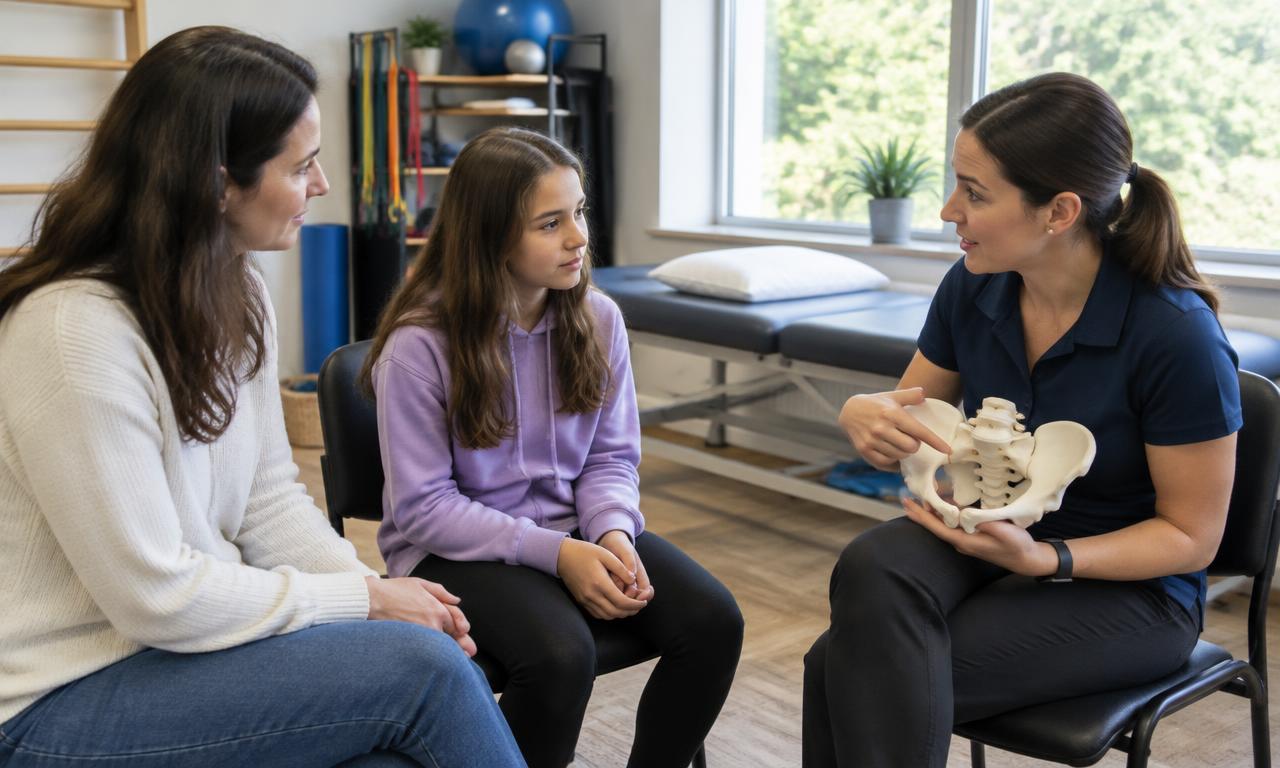
You're in the room every visit and learn the techniques so you can coach at home.
Play-Based, Paced to Your Child
I progress slowly, based on how your child is doing that day, never on a fixed schedule.
Consent-Led
Care can be external or internal depending on your child. Internal treatment is only considered if medically indicated, after full discussion with parent and child, and only if everyone is comfortable.
With your permission I coordinate with your child's pediatrician on diet and medication, because ongoing constipation often needs both the medical and the behavioral piece.
Free Guides You Can Start Using Today
Tell us where to send it and the PDF is yours right away — it downloads instantly and lands in your inbox too.
Combatting Constipation
Evidence-based tips and techniques for improving bowel function and reducing straining.
What is Your Type?
Stool Chart and What it Actually Means
Why Parents Trust Dr. Tanvi Maharaja
Specialized pediatric training, plus years of pelvic and orthopedic expertise.
- Doctor of Physical Therapy (DPT)
- Board Certified Orthopedic Clinical Specialist (OCS)
- Pregnancy and Postpartum Corrective Exercise Specialist (PCES)
- Pediatric Bladder and Bowel Dysfunction training with Dawn Sandalcidi, Levels 1 & 2
- Real-time ultrasound (RUSI) biofeedback for external, child-friendly assessment
- Every visit is one-on-one with Dr. T, never handed off
Your Child's First Visit, Step by Step
No surprises, for you or your child.
- 1
We talk first
You and your child share what's been happening: bathroom habits, accidents, diet, sleep and school.
- 2
We set goals together
Dry nights, no more painful poops, comfortable periods. We agree on what matters most to your family.
- 3
A gentle, external assessment
Posture, breathing, and how the muscles work, often watched together on the ultrasound screen. Anything beyond an external assessment is only discussed later, and only if it is medically needed and everyone is comfortable.
- 4
I explain what I found
In plain language your child can understand too, including what's likely driving the symptoms.
- 5
You leave with a simple home plan
A few fun, doable steps, paced to your child and adjusted at each visit.
What Parents Tell Us
One mom told us she wished they had found us sooner. Her teenage daughter had struggled with inserting and removing a tampon. She said her daughter felt safe and heard, and that progress was taken slowly, visit by visit, based on how her daughter was doing.
Parent of a teen patient
Questions Parents Ask
At what age can my child start pelvic floor therapy?
Treatment is typically appropriate from age 4–5 and up, when children can engage in age-appropriate exercises and biofeedback. Each child is evaluated individually.
Will my child need an internal exam?
Not automatically. Treatment can be external or internal, based on your child's unique presentation. An internal approach is only considered after a thorough discussion and education with both parent and child, if it is medically indicated, and only if everyone is comfortable. Many children are treated entirely externally.
Can pelvic floor therapy help with bedwetting?
Yes. Bedwetting often involves pelvic floor coordination, bladder capacity, and constipation as contributing factors. Therapy addresses all three with a child-friendly, family-centered approach.
How is constipation treated with pelvic floor therapy?
Treatment includes toilet posture training, breathing coordination, abdominal massage techniques, and behavioral strategies. We also coordinate with the child's pediatrician on dietary and medication considerations.
Do I need a referral from my pediatrician?
No referral is required to start. With your permission, I'm happy to share findings with your child's pediatrician or urologist so everyone is working together.
How long is a session, and how is it paid for?
Every visit is one-on-one with Dr. Tanvi Maharaja. We are out-of-network: you pay at the visit by cash, card, HSA or FSA, and we provide a superbill you can submit to your insurance for possible reimbursement.
Do parents stay in the room?
Yes. Pediatric sessions are family-centered. Parents/caregivers are present, learn the techniques, and become coaches at home.
Research and further reading
Urotherapy for children with bladder and bowel dysfunction
This review included 14 studies of moderate methodological quality. Urotherapy—education, fluid habits, toilet positioning, scheduled urination, pelvic floor training and constipation management—was associated with fewer symptoms and improved urine-flow measurements.
Programs and participants differed enough that results could not be pooled in a meta-analysis. It supports a combined bladder-and-bowel approach, not a promise that one technique will resolve every child’s symptoms.
Assis GM, da Silva CPC, Martins G. J Pediatr (Rio J). 2019;95:628–641.Related Articles
Learn more about this condition from our blog
What You Can Expect From Us
You are heard.
A full hour, one-on-one with Dr. Tanvi. Your story matters, and you will never feel rushed.
You understand your body.
We explain what is happening in plain language, so you know why each step of your plan matters.
Care that looks deeper.
We look at you as a whole person, not a list of symptoms, and work toward the root cause.
"We have been to multiple Pelvic Floor Therapists and Tanvi is at an entirely different level."